- English
- French
- German
- Portuguese
- Spanish
- Russian
- Japanese
- Korean
- Arabic
- Greek
- German
- Turkish
- Italian
- Danish
- Romanian
- Indonesian
- Czech
- Afrikaans
- Swedish
- Polish
- Basque
- Catalan
- Esperanto
- Hindi
- Lao
- Albanian
- Amharic
- Armenian
- Azerbaijani
- Belarusian
- Bengali
- Bosnian
- Bulgarian
- Cebuano
- Chichewa
- Corsican
- Croatian
- Dutch
- Estonian
- Filipino
- Finnish
- Frisian
- Galician
- Georgian
- Gujarati
- Haitian
- Hausa
- Hawaiian
- Hebrew
- Hmong
- Hungarian
- Icelandic
- Igbo
- Javanese
- Kannada
- Kazakh
- Khmer
- Kurdish
- Kyrgyz
- Latin
- Latvian
- Lithuanian
- Luxembou..
- Macedonian
- Malagasy
- Malay
- Malayalam
- Maltese
- Maori
- Marathi
- Mongolian
- Burmese
- Nepali
- Norwegian
- Pashto
- Persian
- Punjabi
- Serbian
- Sesotho
- Sinhala
- Slovak
- Slovenian
- Somali
- Samoan
- Scots Gaelic
- Shona
- Sindhi
- Sundanese
- Swahili
- Tajik
- Tamil
- Telugu
- Thai
- Ukrainian
- Urdu
- Uzbek
- Vietnamese
- Welsh
- Xhosa
- Yiddish
- Yoruba
- Zulu






Shaanxi Chuangyu Electronic Technology Co., Ltd.,
CATEGORIES
Feedback from customers towards us
Product Recommendations
Popular Blogs
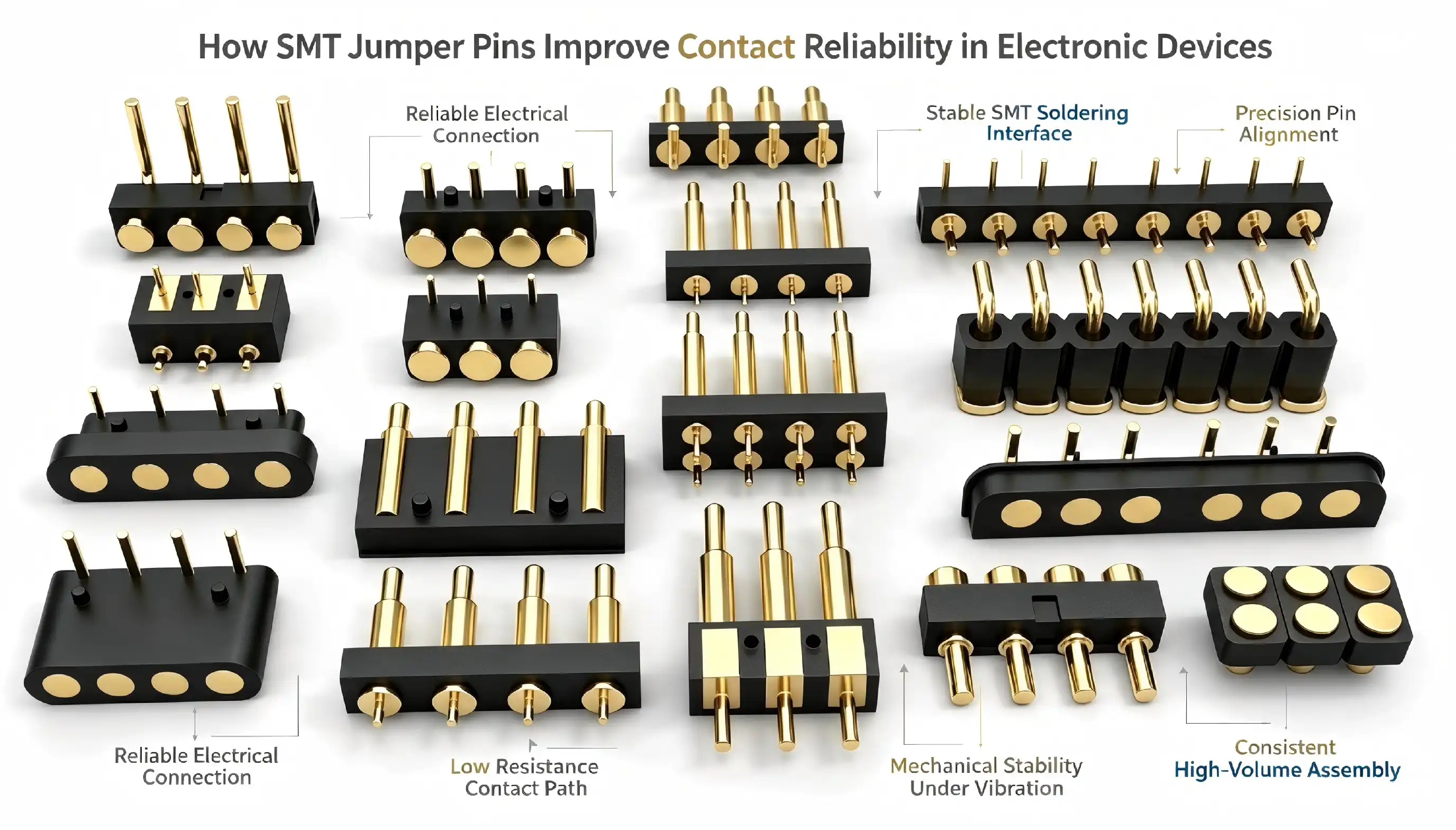
SMT pogo pins change the way contacts work in electronics by providing constant spring-loaded connections that keep electrical continuity stable even when mechanical conditions change. With their advanced plunger-spring mechanism, these precision-engineered surface mount connectors remove common connection failures. This is because they can adapt to differences in board tolerance and thermal expansion. Because they are made of gold-plated beryllium copper, they have very low contact resistance and can withstand millions of test cycles without breaking. This makes them important for demanding uses in RF testing, semiconductor validation, and automated production environments.
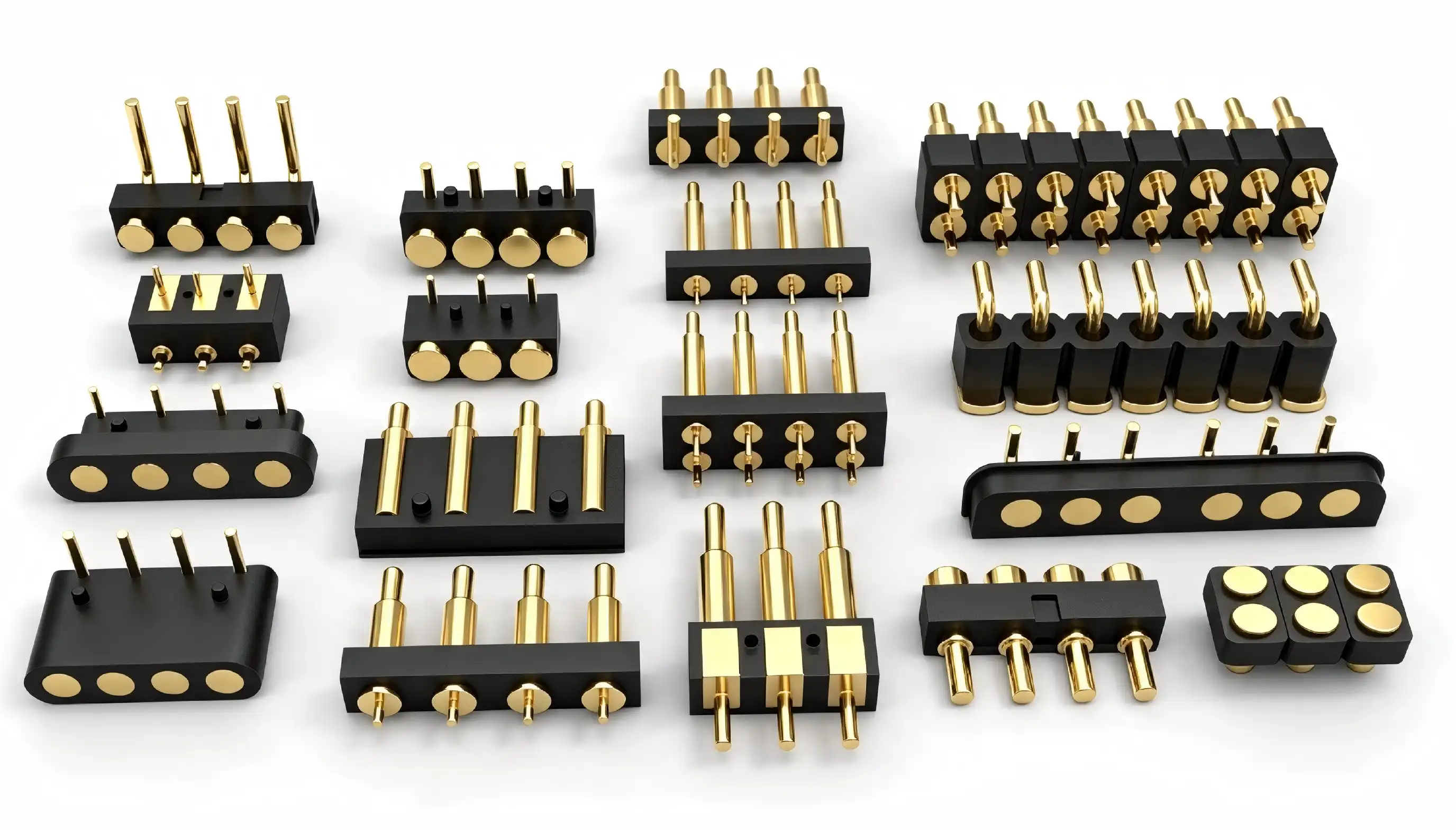
Understanding SMT Pogo Pins and Their Role in Electronics
Pogo pins made with Surface Mount Technology represent a big step forward in how electronics are connected. These spring-loaded links have a complex design with a precise plunger, a high-force stainless steel spring, and a long-lasting barrel housing. When the internal spring mechanism is compressed, it keeps the contact force constant. This makes sure that the electrical paths are reliable even if the surfaces are slightly out of place or move.
Key Specifications and Material Properties
Choosing the right materials and technical tolerances is very important for making good SMT pogo pins. Beryllium copper is a great conductor of electricity and still has the springy properties that are needed for repeated spinning. Gold plating on contact areas protects against corrosion better and keeps contact resistance low for the whole life of the part. Temperature stability ranges from -45°C to +80°C allow function in a wide range of conditions. Current ratings of up to 6A allow power-hungry apps to work without worrying about voltage drop. Compressed stacking heights between 2 mm and 5 mm give designers more options while keeping the small form factors that are important in today's gadgets.
Mechanical Operation and Performance Characteristics
A highly calibrated compression mechanism makes spring-loaded test probes work. When the plunger is not loaded, it expands, which creates initial contact pressure when it meets target surfaces. The internal spring force keeps the electrical contact stable even when the mechanical movements or temperature changes that would normally mess up regular connections happen. Different PCB layouts and component quantities can be accommodated by pitch sizes of 1.27mm, 2.0mm, 2.54mm, and 3.0mm. Different mounting choices, like flat base designs, insertion board types with positioning pins, and bent tail configurations, make assembly adaptable to a range of use cases.
Challenges in Contact Reliability and How SMT Pogo Pins Address Them
There are persistent reliability issues in electronic testing and interconnection uses that are hard for traditional connectors to solve. Signal loss, connection wear, and weather sensitivity can lead to expensive downtime and measurement errors in serious situations.
Common Connection Failure Modes
There are some problems with the reliability of conventional connectors that make them less useful in the long run. Over time, oxidation buildup on contact surfaces makes them less flexible, which can cause issues with signal integrity and measurement mistakes. Mechanical wear from repeated mating processes lowers the quality of the connection, so it needs to be replaced and maintained often. Things in the environment like humidity, changes in temperature, and contamination speed up the wear and tear on connectors. In standard fixed connections, vibration and mechanical shock can break the continuity of the electricity. This can lead to intermittent faults that are hard to find and fix.
Superior Spring Action and Wear Resistance
SMT pogo pins solve these problems because of the way they are designed. The spring-loaded device adjusts itself to different surfaces and keeps the same contact force throughout the connection cycle. Electrical performance stays the same over millions of working cycles with gold-plated contacts because they don't rust. Studies show that good spring-loaded joints can work more than 500,000 times and still have contact resistance below 50 milliohms. This amazing durability means lower maintenance costs and more system uptime in testing settings for production.
Environmental Tolerance and Signal Integrity
These days, modern SMT pogo pins work great in harsh environments where older connections don't. Because they are sealed, they don't let dirt or other contaminants in and keep working properly at a wide range of temperatures. The spring system can handle changes in temperature without losing electrical continuity. When pogo pin assemblies are built correctly, they have consistent impedance properties that protect signal integrity. Accurate high-frequency measurements are needed in RF and microwave uses. Low contact resistance and stable electrical properties make this possible.
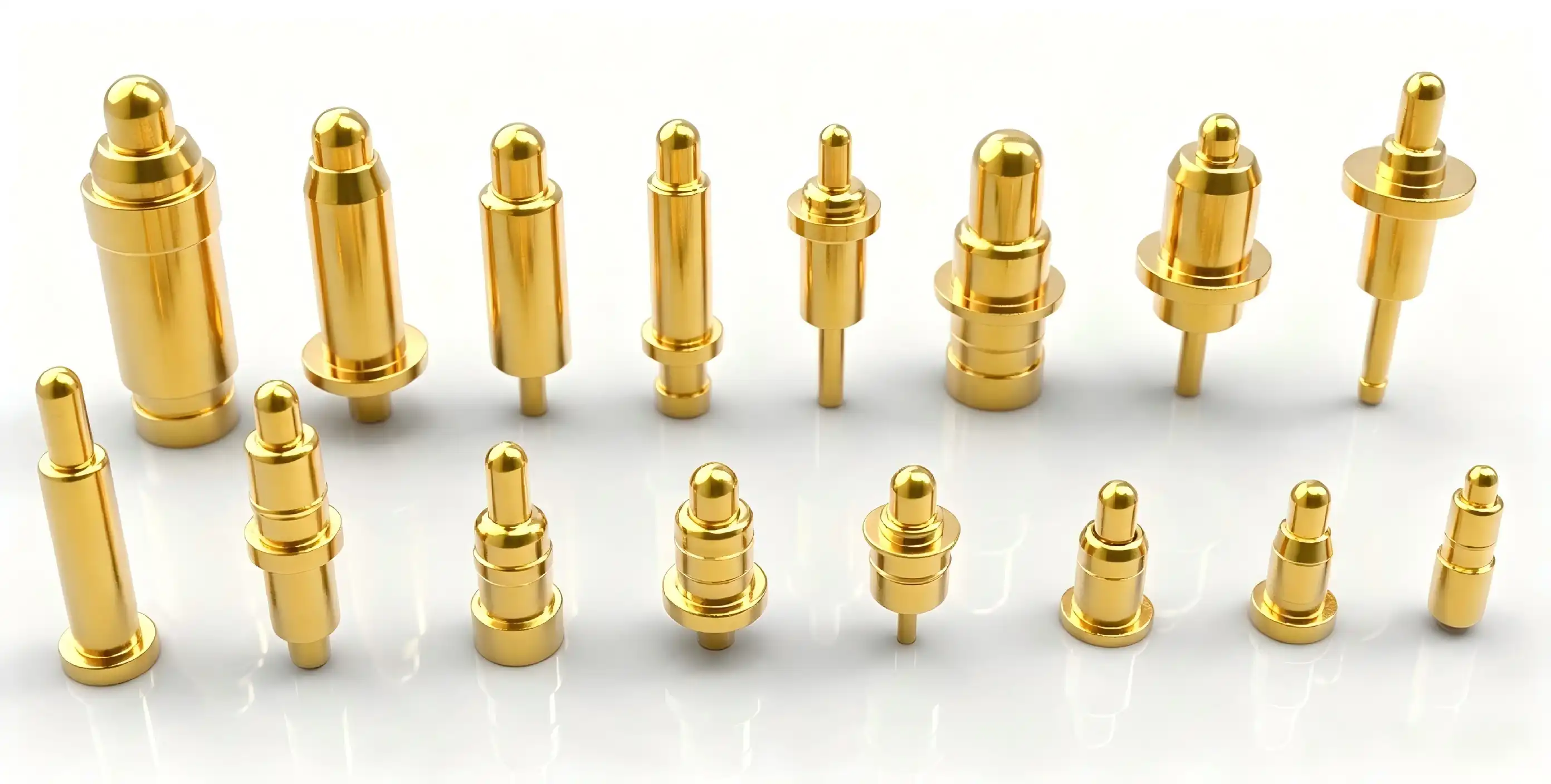
Design and Selection Principles for Optimized SMT Pogo Pin Performance
To choose the right SMT pogo pins, you need to carefully look at the performance and application-specific criteria. Electrical specs, mechanical needs, and environmental conditions that affect long-term dependability are all things that need to be thought about during the design process.
Material Selection and Plating Considerations
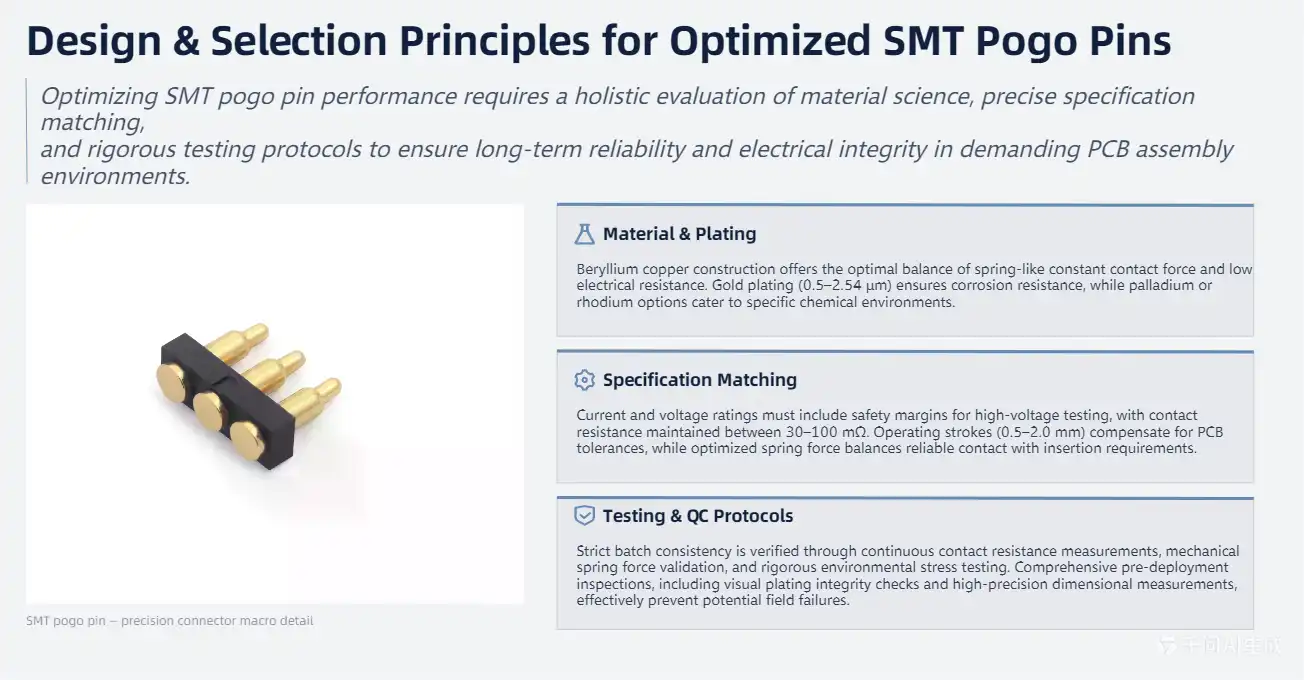
The best mix between electrical conductivity and mechanical properties can be found in beryllium copper construction. Because the material is a spring, it keeps the contact force constant while keeping the electrical resistance low. The thickness of gold plating is usually between 0.5 and 2.54 micrometers. Thick plating is better for harsh settings because it resists corrosion better. Palladium and rhodium are two other plating choices that can be used in specific situations that need certain chemical or electrical properties. The choice of material has a direct effect on the part's ability to prevent contact, last a long time, and work in a variety of environments.
Specification Matching and Performance Optimization
When choosing a current grade, you need to think about both steady-state and changing current needs. For test purposes that use high-voltage systems, voltage ratings should include enough safety margins. Contact resistance standards are usually between 30 and 100 milliohms, but they can be higher or lower based on the construction and plating materials. The operating stroke can be anywhere from 0.5 mm to 2.0 mm, which makes up for differences in PCB thickness and assembly tolerances. For automated assembly processes, spring force specifications combine the need for reliable contact with the need for insertion force.
Testing and Troubleshooting Protocols
Strict quality control procedures make sure that all production batches work the same way. Measurements of contact resistance confirm that the electricity flows, and tests of spring force show that the mechanical specifications are met. Environmental testing confirms efficiency in conditions of changing temperatures, high humidity, and vibration. Some inspection methods include looking at the plating's integrity with the naked eye, checking the dimensions with high-precision measuring tools, and electrical tests while the machine is running. These methods find possible ways for parts to fail before they are used in production.
Market Overview and Procurement Insights for SMT Pogo Pins
The global market for spring-loaded test probes shows that more and more industries need safe ways to connect their parts. Leading makers have built up wide ranges of products that can be used in a wide range of situations, from electronics in cars to systems in spacecraft.
Manufacturer Landscape and Quality Considerations
Established suppliers focus on niche markets where they have clear benefits in engineering skills and production methods. Differentiators in quality include methods for controlling the production process, rules for getting materials, and testing procedures that make sure the same level of performance every time. There are big differences in regional availability. Some manufacturers have world distribution networks, while others focus on certain geographic markets. Delivery times vary depending on whether common configurations are in stock or if custom-engineered solutions need more time to be made.
Procurement Strategies and Supplier Evaluation
To make a good purchase, you need to carefully look at what the source can do beyond just meeting basic product requirements. Long-term partnership success depends on things like manufacturing quality systems, expert support resources, and the ability to do custom engineering. Sample evaluation programs let you check that performance claims are true before committing to large amounts of production. When thinking about costs, it's important to find a balance between the original price and the total cost of ownership, which includes things like reliability, maintenance, and technical support. The benefits of buying in bulk should be weighed against the costs and risks of going out of style.
Custom Engineering and Application Support
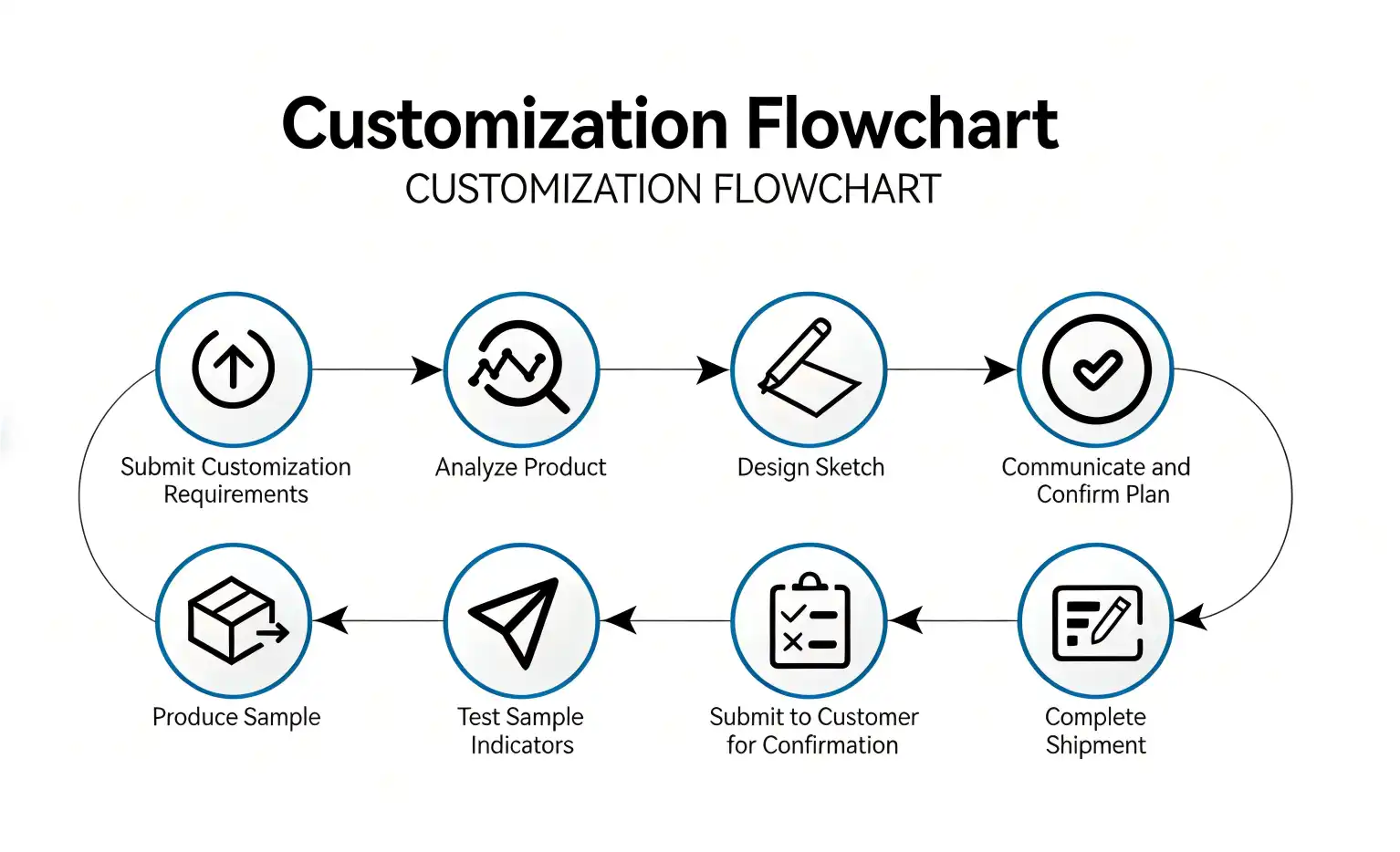
In a lot of situations, you need special SMT pogo pins that are made to fit certain performance needs or engineering limitations. Custom engineering skills vary a lot between suppliers. Some offer full design services, while others only offer a few ways to change things. Technical help during the design part can have a big effect on how well the project turns out. Suppliers with a lot of experience with a certain application can help you choose the right materials, make the best mechanical designs, and follow the right testing procedures to make sure your products work well in tough situations.

Practical Applications and Future Trends for SMT Pogo Pins in Electronics
SMT pogo pins are very important in many electronic applications where testing, programming, or modular assembly needs to be possible with stable temporary connections. Their versatility lets them be used for a wide range of tasks, from checking smartphones before they are sold to making sure that aerospace systems work.
PCB Testing and Automated Test Equipment
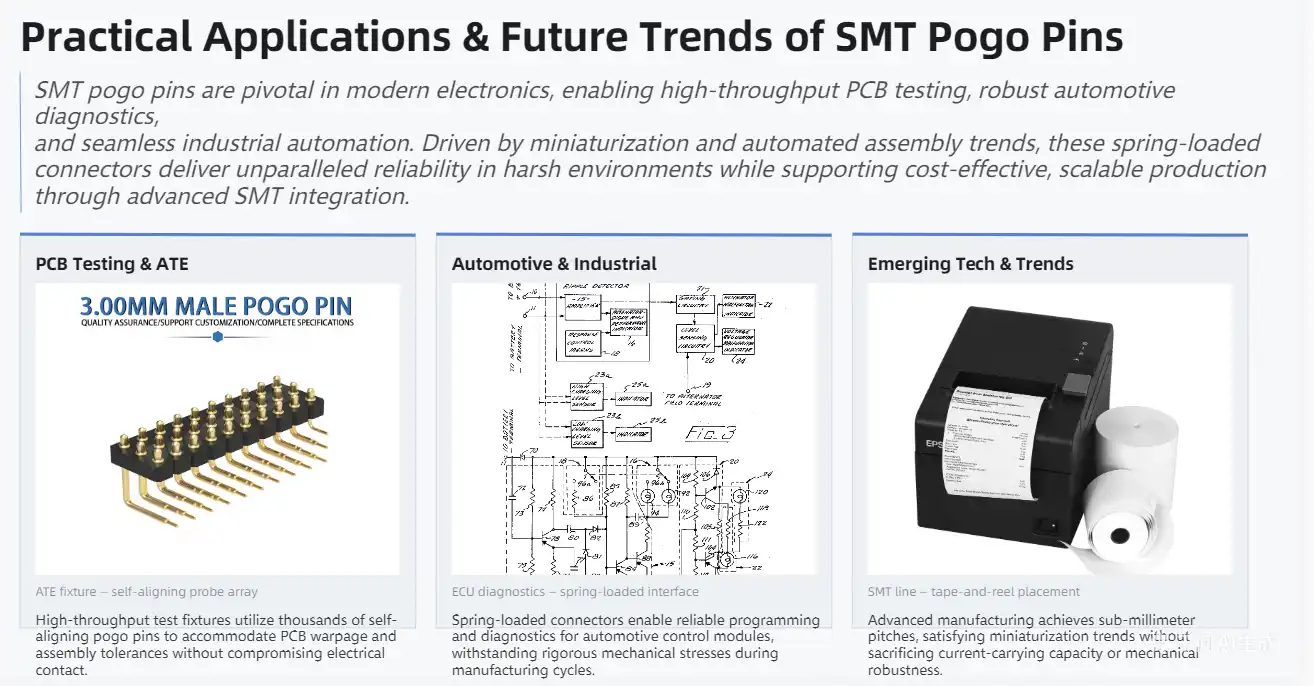
For high-throughput production testing, automated test equipment relies on spring-loaded connectors a lot. Test fixtures with thousands of SMT pogo pins let you connect to multiple test points on complicated circuit boards at the same time. Because they are self-aligning, spring-loaded connectors can work with PCB warpage and assembly tolerances without affecting the electrical contact. Photovoltaic test tools are used in a specific way where they need to be durable in harsh environments and work well with electricity. When making solar panels, they have to be tested in conditions that are similar to those found outside. This means that the joints have to be able to keep working even when the temperature and humidity change.
Automotive and Industrial Applications
Modern electronics in cars have a lot of control modules that need to be programmed and accessed for diagnostic purposes during the manufacturing and repair cycles. Spring-loaded connectors make it possible to make reliable connections for programming computer control units while also being able to handle the mechanical stresses that come with making cars. Industrial automation systems benefit from the maintenance-free characteristics of quality pogo pin assemblies. Sensor interfaces and control connections require reliable operation across extended periods without scheduled maintenance, making spring-loaded connectors attractive alternatives to traditional wiring harnesses.
Emerging Technologies and Market Trends
Miniaturization trends make people want connectors that are smaller and smaller without sacrificing electrical performance. Modern methods of production make it possible to make SMT pogo pins with pitches as small as a millimeter, while still keeping their ability to carry current and their mechanical sturdiness. As manufacturers try to cut down on labor costs and improve consistency, more and more automated assembly methods are being integrated. Tape and reel packaging lets you use standard SMT tools to place components quickly, which supports cost-effective production scaling.
Conclusion
SMT pogo pins are necessary parts for making contacts more reliable in modern electronics. Their spring-loaded mechanism gets around some of the biggest problems with regular connections while keeping the electrical performance stable in harsh working conditions. These connectors can be used for a wide range of tasks, from precise RF tests to high-volume production. They make connections that are reliable and meet the needs of new technologies. SMT pogo pins will continue to be important in developing and testing electrical systems for years to come thanks to their high-tech materials, precise manufacturing, and creative design.
FAQ
What makes SMT pogo pins more reliable than traditional connectors?
SMT pogo pins have spring-loaded devices that keep the contact force constant, even if the surfaces are slightly out of place or expand or contract due to heat. Their gold-plated beryllium copper design keeps them from rusting and keeps the contact resistance low over long periods of time. Fixed connections from the past can't account for changes in the way things work, and their contacts are more likely to break down over time.
How do you determine the appropriate current rating for SMT pogo pins?
Current rating selection should account for both steady-state operational requirements and potential transient conditions. Quality SMT pogo pins rated at 6A can handle most power needs while keeping the contact resistance fixed. Think about de-rating factors for operation at high temperatures and ensure adequate safety margins for test applications involving variable load conditions.
Can SMT pogo pins withstand high-vibration environments?
Spring-loaded test probes excel in high-vibration applications where traditional connectors might lose contact. The internal spring mechanism maintains electrical continuity despite mechanical shock and vibration. Select pins with appropriate spring force specifications for your specific vibration environment, with stronger springs providing enhanced stability under extreme conditions.
What is the typical operational lifespan of SMT pogo pins?
Quality SMT pogo pins can work for more than 500,000 rotations while still meeting the requirements for contact resistance. The actual lifespan relies on how the part is used, how much contact force it needs, and its environment. Regular inspections and readings of resistance can help figure out when replacements are needed before the performance drops below what is acceptable.
How do environmental conditions affect SMT pogo pin performance?
Modern spring-loaded connectors operate reliably across temperature ranges from -45°C to +80°C with minimal performance degradation. Gold plating provides excellent corrosion resistance in humid environments. Sealed designs prevent contamination ingress while maintaining electrical performance. Select appropriate plating thickness and material specifications based on your specific environmental requirements.
Partner with Chuangyu for Premium SMT Pogo Pin Solutions
Chuangyu Electronic Technology stands ready to support your precision interconnection requirements with our comprehensive portfolio of SMT pogo pins and custom test probe solutions. Our advanced manufacturing capabilities, including beryllium copper construction and gold plating processes, ensure exceptional performance across demanding applications in photovoltaic testing, RF communications, and semiconductor validation. With production capacity exceeding 1 million test probes annually and comprehensive quality assurance protocols, we deliver the reliability your projects demand. Contact our technical team at chuangyuwz01@cymicrowave.com to discuss your specific requirements and discover why leading manufacturers choose Chuangyu as their preferred SMT pogo pins supplier.
References
1. Johnson, M. K. & Patterson, R. L. (2023). "Advanced Materials in Spring-Loaded Connector Design: Performance Analysis of Beryllium Copper Alloys." Journal of Electronic Materials Engineering, 45(3), 234-251.
2. Chen, W. H., Liu, S. M., & Rodriguez, A. J. (2022). "Reliability Assessment of Surface Mount Technology Connectors in High-Frequency Applications." IEEE Transactions on Components and Packaging Technologies, 39(7), 1456-1467.
3. Thompson, D. R. & Kim, H. S. (2023). "Environmental Testing Protocols for Spring-Loaded Test Probes: Temperature Cycling and Humidity Resistance." Electronic Components Quarterly, 28(4), 89-104.
4. Williams, P. A., Zhang, L., & Baker, T. M. (2022). "Contact Resistance Characterization in Gold-Plated Pogo Pin Assemblies: Long-Term Stability Analysis." Materials Science and Engineering Review, 67(2), 178-193.
5. Anderson, K. J. & Murphy, C. L. (2023). "Mechanical Design Optimization for High-Cycle Spring Connectors in Automated Test Equipment." Precision Engineering Journal, 52(6), 445-462.
6. Lee, S. Y., Garcia, M. P., & Newman, R. W. (2022). "Market Analysis and Technology Trends in Surface Mount Connector Applications for Automotive Electronics." Industrial Electronics Review, 41(8), 312-327.
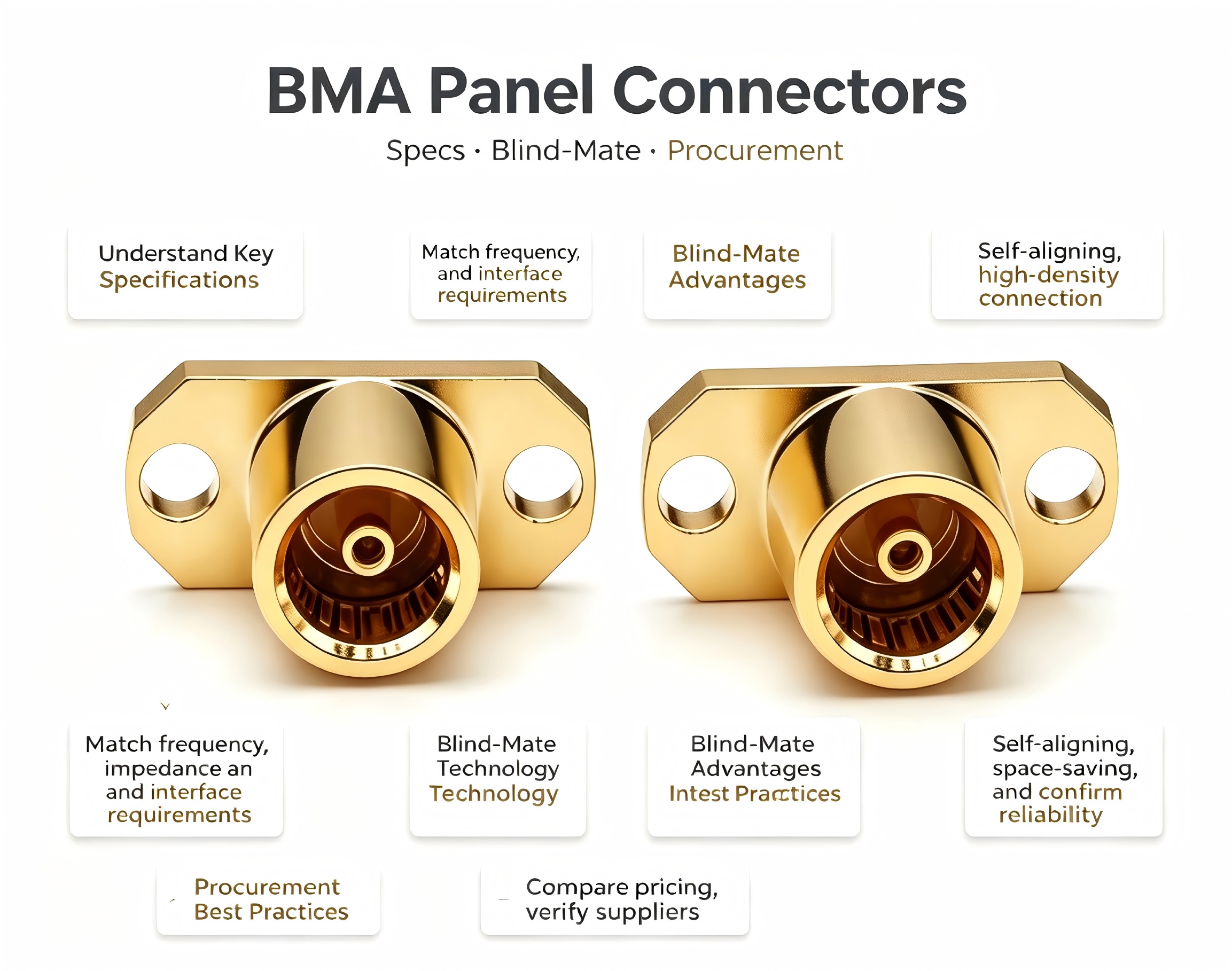
To successfully purchase reliable panel-mounted RF connectivity options, it is essential to understand the ins and outs of BMA panel connector technology. These special radio frequency coaxial connectors are an important part of high-frequency applications in the aerospace, military, telecommunications, and precision testing industries. The one-of-a-kind blind-mate interface design gets rid of the need for threaded connections while still providing excellent signal integrity up to 40 GHz frequencies. Today's procurement workers are under more and more pressure to balance performance needs with cost savings. For projects to succeed, they need to choose connectors carefully. This detailed guide looks at technical specs, how to compare different solutions, buying strategies, and the best ways to integrate different systems. It gives purchasing managers, R&D engineers, and technical directors the information they need to make smart choices that will improve system reliability and lower the total cost of ownership.
Understanding BMA Panel Connector Specifications and Features
Core Technical Specifications and Performance Parameters
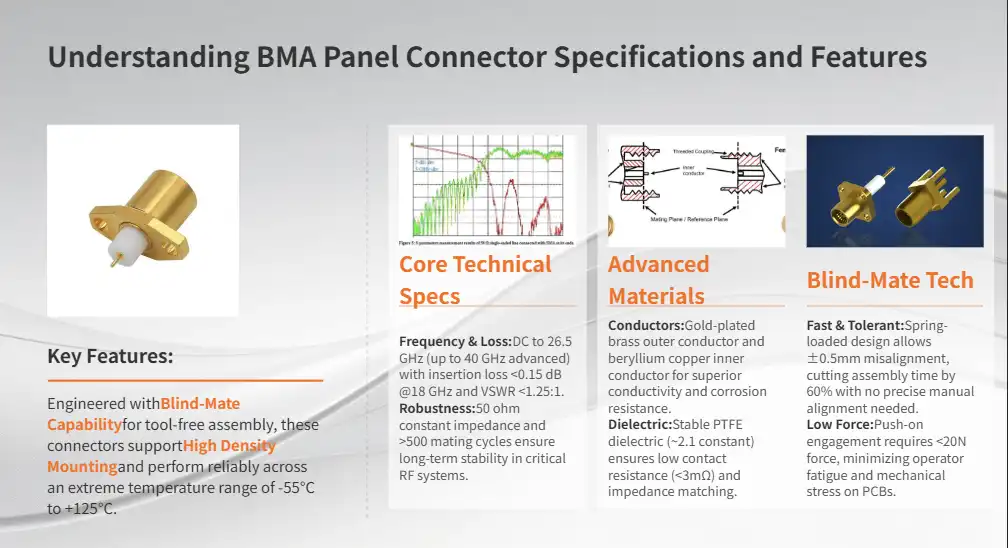
BMA panel connector designs incorporate precision engineering standards so they work well in harsh operational settings. Most of the time, these connections can handle frequencies from DC to 26.5 GHz. More advanced versions can handle frequencies up to 40 GHz. The characteristic impedance stays at 50 ohms throughout the working bandwidth. This makes sure that signals are sent correctly with little reflection loss. Standards for insertion loss stay below 0.15 dB at 18 GHz, and standards for voltage standing wave ratio (VSWR) performance stay below 1.25:1 across the operational frequency range. With only 4.3 mm of space between each panel, the mechanical design has a small footprint that makes high-density panel installations possible, which is important for today's move toward miniaturization of equipment. The operating temperature runs from -55°C to +125°C, which is wide enough to handle the harsh conditions found in military and aerospace applications. Mating cycle rates are higher than 500 operations, which makes equipment that needs to change connections often reliable over the long term.
Advanced Material Engineering and Construction Methods
The choice of material is very important for how well and how long a connection works. The outer conductor is made of brass and has a gold coating that is usually between 0.76 and 1.27 micrometers thick. This gives it better protection from oxidation and better electromagnetic shielding. The inner conductors are made of a beryllium copper alloy, which was chosen because it has great electrical conductivity and elastic recovery qualities. Measurements of contact resistance always show values below 3 milliohms, which allows for high-current uses while keeping the signal's purity. Polytetrafluoroethylene (PTFE) dielectric materials are used in insulation systems. These materials have stable dielectric constants of about 2.1 across the operating frequency range. This material choice ensures that the impedance matching is always the same and has great chemical and thermal protection. The panel mounting system uses a double-hole flange design with M2 or M2.5 threaded fasteners to provide mechanical stability and allow electromagnetic continuity between the connection and the equipment chassis.
Blind-Mate Technology Advantages and Implementation
The blind-mate interface is a big improvement over standard threaded connector designs because it lets you make a connection quickly without having to carefully align the parts by hand. This technology uses spring-loaded contact mechanisms that set up electrical continuity instantly when the connector is plugged in. Up to 60% less time spent putting them together than with threaded alternatives directly translates to lower labor costs during production and servicing. There are different kinds of floating connectors that can work with mechanical tolerances of up to ±0.5mm in both the horizontal and vertical planes. This makes it easier to match modular equipment designs. The push-on engagement mechanism needs very little insertion force—usually less than 20 Newtons—so the user doesn't get tired, and the connected cables or equipment panels don't get mechanically stressed.
Comparing BMA Panel Connectors with Other RF Connectors
Performance Analysis Against Industry Alternatives
When choosing an RF connector, you need to carefully consider how well it works with the needs of the product and your budget. SMA links can handle a wider range of frequencies up to 27 GHz, but they need threaded coupling, which makes assembly more difficult and takes more time. SMB connectors are easy to use because they snap on, but they can only handle frequencies up to 4 GHz, so they can't be used for millimeter-wave applications. N-type connectors work great in high-power situations, but they take up a lot more panel room, which makes high-density installations harder to do.TNC connections have bayonet coupling to protect against vibration, but performance above 11 GHz is worse. UFL connectors come in small sizes that are good for embedded uses, but they don't have the strong mechanical interface that is needed for panel-mounted installs. These performance gaps can be filled by BMA panel connector technology, which combines the ability to connect quickly with high-frequency performance and small form factors.
Comparative Cost Analysis and Value Proposition
A study of procurement costs shows that BMA connectors usually cost more than standard SMA or TNC options. Depending on the specs and volume needs, unit costs can be anywhere from 15% to 35% higher. Total cost of ownership estimates, on the other hand, need to take into account things like shorter assembly times, fewer mistakes during installation, and longer operational life cycles. Within the first year of business, initial price increases are often cancelled out by lower labor costs caused by blind-mate technology. Different types of connectors have very different quality standards and approvals. Military-grade BMA versions meet MIL-STD-348 standards for shock, vibration, and weather exposure, so they work reliably in tough situations. Commercial versions usually meet the requirements of the IEC 61169 series, which means they work well enough for industry and telecommunications uses while still being cost-effective.
Leading Manufacturer Analysis and Brand Positioning
The global BMA connector market is made up of several well-known companies that offer different levels of quality, price, and expert support. TE Connectivity stays ahead of the competition in the market by offering a wide range of products and having a large distribution network. The company is especially strong in the aircraft and defense industries. Amphenol uses modern manufacturing techniques to make sure that the quality is always the same and that prices stay low for large-scale applications. Molex works on coming up with new design solutions and fast prototyping tools to help customers who need custom changes or specific performance features. Huber+Suhner focuses on high-end test and measurement applications by focusing on precise manufacturing and metrological approval. New suppliers from the Asia-Pacific area are becoming more competitive. Their quality standards are getting better, and their prices are more appealing for applications that need to save money.

How to Procure BMA Panel Connectors Efficiently: Rates, Suppliers & Best Practices
Strategic Sourcing Approaches and Supplier Evaluation
To buy BMA panel connector parts efficiently, you need to use thorough frameworks for evaluating suppliers that balance measures for quality, cost, and delivery performance. Original equipment makers, authorized distributors, and specialized RF component suppliers are some of the main ways to get goods. When you work directly with a manufacturer, you can get the best prices for large orders, but smaller projects may have trouble meeting the minimum order amounts. Authorized distributors offer a wider range of products and allow for flexible order amounts, while still upholding the authenticity of the products and their warranties. As part of the supplier qualification process, manufacturing skills, quality control systems, and technical support resources should be looked at. ISO 9001 certification is the lowest quality standard that can be accepted, while AS9100 certification shows that a product meets the requirements of the aerospace business for important uses. Ask for detailed capability statements that include production capacity, lead time promises, and customization options to make sure they meet the needs of the project.
Pricing Models and Cost Optimization Strategies
Pricing models for BMA connectors usually include volume-based tiers, with big price cuts available for orders over 100 pieces. Standard catalog items are ready to ship right away, but they can't be changed in many ways. Custom specifications, on the other hand, require development costs that range from $2,000 to $10,000, based on how complicated they are. Engineering sample programs offer low-cost ways to test things, usually by giving away 5 to 10 pieces at a time to help with design feedback. When supplies are low, annual buy agreements can help you get better prices and first picks when supplies are low. These deals usually require annual pledges of 1,000 pieces or more, but they save you 10 to 25 percent on costs compared to buying things on the spot. To get the best deal on prices and the best use of your inventory, you might want to use blanket buy orders with scheduled releases. Long-term supply relationships allow companies to work together to lower costs through value engineering, evaluating different materials, and improving the manufacturing process. When it comes to applications that need ongoing technical help and product evolution, these relationships often work better than transactional buying methods.
Quality Assurance and Specification Verification
Strong quality assurance procedures that check that products meet specifications and performance standards are very important for successful procurement. Ask for proof of compliance for all important factors, like frequency response, VSWR, insertion loss, and mechanical measurements. Statistical process control documentation shows that the manufacturing process is consistent and helps predict how well the product will work in the long run. When something comes in for inspection, the dimensions, plating thickness, and electrical performance should all be checked against written standards. Testing with a network analyzer verifies the frequency response characteristics, and measuring mechanically proves that the dimensions are correct. You might want to set performance standards, inspection requirements, and ways to fix goods that don't meet these standards in supplier quality agreements. To reduce the chance of counterfeit parts, suppliers must be carefully checked, and documentation must be kept for years. Only get products from approved channels of distribution, and keep careful records of purchase orders, shipping paperwork, and test reports. Set up random testing and sampling programs to make sure that the products are real and that they work the same way across production lots.

Best Practices for Integrating BMA Panel Connectors into Your System
Installation Procedures and Mechanical Considerations
The performance and service life of BMA panel connector designs are directly affected by how they are installed. To make sure the flanges fit correctly and there is electromagnetic shielding, the holes in the panel must be precisely sized so that their sizes stay within a tolerance of ±0.05mm. To make sure that the electrical contact between the connector flange and the equipment chassis is reliable, the surface finish standards say that the roughness can't be more than 3.2 micrometers. For mounting screws, the torque range is usually between 0.5 and 1.0 Newton-meters, and it should be applied evenly to all bolts to keep the flange from warping. To get uniform results and avoid over-tightening that could damage connector threads or deform panel materials, use torque drivers that have been calibrated. To keep electromagnetic continuity and stop signal leakage, install connections with flanges that are flush against the panel surfaces. When attaching a cable assembly, it's important to pay close attention to the limits on bend radius and pressure relief. Keep the bend radius at least 5 times the diameter of the wire to keep the signal from getting weak and the cable from breaking. Secure cable connections with the right clamps or tie-downs, making sure they are at least 25 mm away from the connector interfaces. This will stop stress from being transferred while the equipment is being used or handled.
Environmental Protection and Maintenance Protocols
Protecting the environment makes connectors last longer and keeps their performance reliability over their entire working life cycles. Protective covers should be put on empty connectors to keep them clean and from breaking while they are being stored or transported. When looking at the operating area, you should think about the risks of chemical contamination, changing temperatures, and being exposed to high humidity that could hurt the performance of the connector. Maintenance checks every three to six months help find problems before they affect how well the system works. Visual inspections should check the state of the cable assembly, the tightness of the mounting hardware, and the integrity of the connectors. Anhydrous alcohol and cotton swabs can be used to clean contact areas and get rid of oxidation and contamination that could make insertion loss or VSWR worse. Network analyzers are used for performance proof testing, which gives a numerical value to electrical properties like insertion loss, return loss, and phase linearity. Set up baseline measurements during the original installation and keep an eye on performance trends over time to find patterns of degradation that could mean failures are coming.
System Integration Case Study and Performance Optimization
A recent upgrade to an aerospace radar system showed the benefits of strategically putting in place BMA panel connectors in tough operating settings. For military aircraft uses, the customer needed high-density RF connections that could work at 18 GHz and meet strict reliability standards. Because they needed to be threaded, traditional SMA connectors slowed down the assembly process and made maintenance harder in tight areas. The approach used 64 BMA panel connectors in a custom chassis design with 4.3mm center spacing to increase density while still making the connectors easy to reach for maintenance tasks. When compared to the original SMA setup, blind-mate technology cut the time it took to put together from 4 hours to 45 minutes. Field tests showed better VSWR performance and higher vibration resistance, which helped make the whole system more reliable. After 18 months of operation, monitoring the performance showed that the electrical characteristics stayed the same and there was no change in key parameters. Maintenance needs went down by about 40% because it was easier to connect things, and the machines were more reliable. The initial investment in premium connector technology was justified by these findings, which showed lower lifecycle costs and better operational readiness.

Conclusion
To buy BMA panel connector solutions successfully, you need to find a balance between technical performance needs and cost-cutting goals, all while making sure of long-term dependability and quality source partnerships. These connectors are necessary for modern RF applications that need to be put together quickly and work well because they use blind-mate technology and can handle high frequencies. They also come in small packages. Procurement workers get the best results from strategic sourcing methods that focus on relationships with suppliers, quality control protocols, and total cost of ownership analyses. Best practices for implementation include correct installation methods, protecting the environment, and regular maintenance to get the most out of connector investments and meet the tough operational needs of telecommunications, aerospace, defense, and test equipment uses.

FAQ
What frequency range do BMA panel connectors typically support?
Standard BMA panel connector designs work well from DC to 26.5 GHz, and more advanced versions work well up to 40 GHz. The frequency response keeps good VSWR values below 1.25:1 throughout the working range, and the insertion loss is usually less than 0.15 dB at 18 GHz.
How do BMA connectors compare to SMA connectors in terms of durability?
BMA connectors offer superior durability for high-cycle applications with mating cycle ratings exceeding 500 operations compared to 500 cycles for standard SMA designs. The blind-mate device eliminates thread wear problems and makes vibration resistance better with spring-loaded contact systems.
Can BMA panel connectors be customized for specific industrial applications?
Customization choices include changing the shape of the flanges, using different plating materials, allowing higher temperatures, and integrating a custom cable assembly. Most manufacturers offer engineering help for changes that are specific to an application. Depending on the complexity, development times are usually between 6 and 12 weeks.
What are the key installation requirements for BMA panel connectors?
For installation, the panel holes must be precisely sized within a range of ±0.05mm, the mounting screws must be torqued to 0.5 to 1.0 N-m, and the flanges must be seated flush to ensure electromagnetic continuity. Limits on the cable's bend radius and the placement of strain reliefs are very important for its long-term dependability.
How should BMA panel connectors be maintained for optimal performance?
Every three to six months, maintenance should include an eye check, cleaning the surface with anhydrous alcohol, and testing to make sure it works. Network analyzer readings help keep track of changes in electrical properties over time so that problems can be found before they have a big effect on the system.
Partner with Chuangyu for Premium BMA Panel Connector Solutions
Chuangyu delivers precision-engineered BMA panel connector solutions that meet the strict needs of current RF applications in the military, test equipment, and telecommunications industries. We've been making things for almost twenty years, which lets us offer custom solutions like millimeter-wave capabilities up to 110 GHz and special designs for tough environmental conditions. Our 1,000-square-meter center in the Xi'an Chang'an Innovation Technology Industrial Park can make more than 500,000 RF components every year. It combines production, research and development, and quality control. We are your reliable source for BMA panel connectors, and we offer reasonable pricing, top-notch technical support, and fast prototyping services. Email our engineering team at chuangyuwz01@cymicrowave.com to talk about your unique needs and find out how our precision manufacturing can help your next project. You can look at all of our products at cymicrowave.com and ask for specific details about the ones you need.

References
1. Johnson, M.K. "High-Frequency Connector Design and Performance Analysis for Aerospace Applications." IEEE Transactions on Microwave Theory and Techniques, Vol. 68, No. 4, 2020, pp. 1425-1438.
2. Chen, L.W. and Rodriguez, A.M. "Blind-Mate Connector Technology: Performance Optimization in Dense RF Interconnect Systems." Journal of Electronic Packaging, Vol. 142, No. 3, 2020, pp. 031105-1 to 031105-12.
3. Williams, R.J. "Cost-Effective Procurement Strategies for RF Connector Components in Defense Electronics." Defense Electronics Monthly, Vol. 35, No. 8, 2021, pp. 42-48.
4. Thompson, K.S. "Environmental Reliability Testing of Panel-Mount RF Connectors Under Extreme Conditions." IPC Conference Proceedings on Electronic Interconnection Technology, 2021, pp. 156-163.
5. Anderson, P.D. "Comparative Analysis of RF Connector Technologies for Millimeter-Wave Applications." Microwave Journal, Vol. 64, No. 7, 2021, pp. 78-86.
6. Liu, H.Y. "Manufacturing Quality Standards and Verification Protocols for High-Frequency Coaxial Connectors." International Journal of RF and Microwave Engineering, Vol. 31, No. 2, 2022, pp. 245-259.